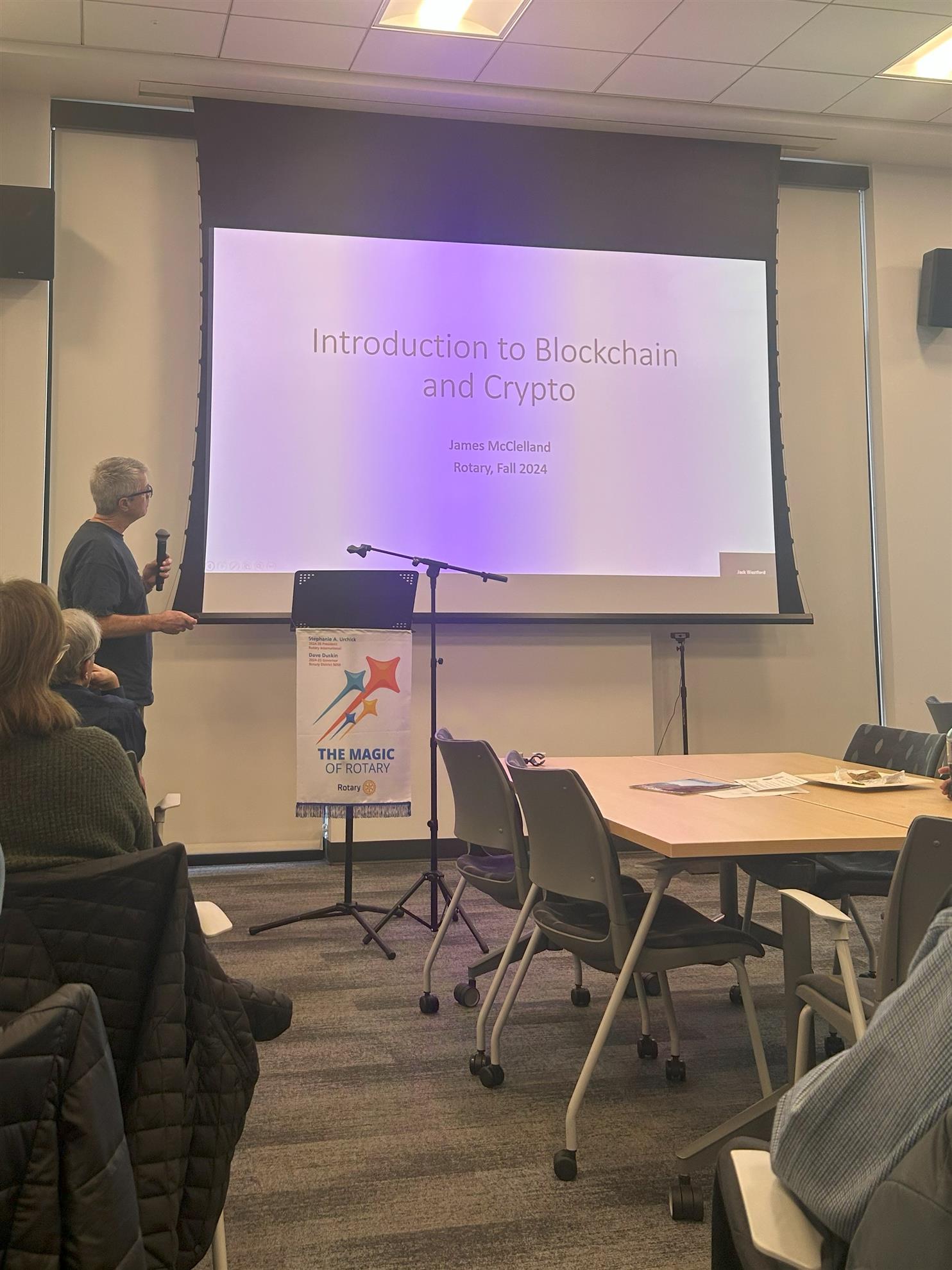
Mark Knittel introduced Jamie McClelland, a personal friend. He said that Jamie is forever investigating and researching. One of the areas is crypto currency and block chain technology. Blockchain is an idea that will become the foundation of solutions to a lot of future problems. What problem does block chain try to solve you ask…slow, expensive record-keeping. Blockchain is very good at record-keeping. It will be extremely useful in the real estate and financial industries, for instance.
After a very short history of blockchain Mr. McClelland, he launched into reasons to embrace the concept. He noted that every credit card company and investment bank has a block chain now. Some state pension funds are investing in it. There is even talk of a bitcoin strategic reserve.
Venmo, Pay Pal and Apple Pay are now using crypto currency. Ethereum has made transactions much cheaper and faster to use. The head of Robin Hood, a brokerage, said that it is roughly one order of magnitude cheaper to run a block chain financial business than a similar traditional financial firm.
Jamie then gave a short analogy of how a blockchain could work to keep bets on a golf game secure. One of the golfers creates a ledger to keep a record. And if this ledger is unavailable for some reason, the whole thing comes to a complete stop. Or if others want to be included, problems arise. Putting all this in a spreadsheet and then putting the spreadsheet online so anyone can use it could be a solution. But if anyone can use it – the spreadsheet is not secure. The block chain has two requirements: a password and also a balance requirement. Without both any entry is rejected. To avoid the problem of computer crashes, a network of computers is used. All work on identical copies. So, it is crash-resistant.
Devices now are available to generate cryptographically secure addresses and passwords, (public key and private key). Jamie stated that to crack these keys would take about a billion, billion years with current technology. So, they are super secure. To keep the spreadsheet secure, a hash function is used. Add up the transactions, take the square root, drop off the integer in front of the decimal point. If any entry is changed, the hash is changed and you know there is a false entry in this block. Every 10 minutes for Bitcoin, every 12 seconds for Ethereum a set of transactions is reconciled as a block.
The hash is used to connect the blocks together into a chain. Thus, the block chain. The hash from block one is added above the first entry of block two and thus a new and unique hash is created for block two. The block two hash goes in front of the first entry in block three again creating a unique hash for block three. And on and on.
Any change in any entry at any time in history, and it is recognized by comparing to the rest of the block chain universe and the offender is financially penalized. This is its primary utility. These databases are immutable, always on and public (cryptographically secure).
Other uses of block chain are: property rights, recording fees, remittances, improving global supply chains, resale of used items, like books so the author gets some income from the resale of a used book. But maybe the most popular use, at least in some countries is digital dollars, (crypto currency).
Block chains are open, public, world-wide, secure, owned by no one, allow better cheaper data storage, (the pathway to the future???)
A suitable smack of the bell closed the meeting.