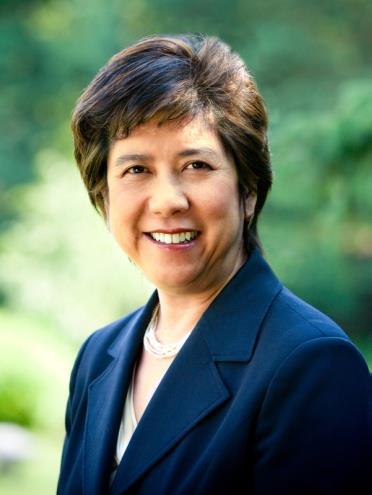
Our own Kathi Hiyane-Brown then took the virtual stage as our featured speaker with a talk about WCC “Navigating Uncharted Waters of a Global Pandemic”. Kathi opened by stating that Whatcom Community College has been totally driven by the safety of its Students, Faculty and Staff. They have been guided by science and law, and get tremendous support and guidance from the Governor’s office, local health authorities and experts at the University of Washington. She also offered to share lessons in leadership learned so far during the pandemic.
Moving to online instruction so suddenly in March was a multi-faceted challenge. They received the initial email about Covid on February 4th, canceled instruction on March 11 and resumed online on March 23. And just in time, as the first known Covid case on campus was recorded on March 27th. Technology, communication, culture and logistics have all required thought and significant effort. For example:
WCC learned that while pre-Covid the College had an excellent record with online instruction, the new scale meant that some students and faculty who do not thrive online needed extra support. There was intensive training to help faculty adapt their courses. Since on-campus computer labs were closed, WCC had to find ways to provide hardware, software and in some cases internet access to students. They even set up wi-fi access from the parking lot so students could work from their cars. Getting textbooks to students required another set of innovations, as was re-formulating lab experiments so students could perform them at home. Remarkably, a ceramics instructor figured out a way to teach their typically very “hands-on” course to students learning remotely.
WCC remains 100% online for Fall quarter and will soon make a decision about Winter quarter. This is not an easy call, since the number of students, the status of the virus and associated restrictions required, and essential state funding are all unknown and will remain so for weeks or months after a decision is made. By requiring 100% online classes, Covid-19 has resulted in a radical adaptation of community college education, including:
· Learning new ways to support students and faculty in safe and effective fashion
· Relying heavily on technology resources, and recognizing that access to them is uneven among students
· Redesigning classes and labs
· Incurring additional expenses such as PPE, extra cleaning and staff support
Looking forward, the current estimate is for 10-15% in reduced State funding to the College. This is in a period of higher costs and expected reduced enrollment – reductions expected to be in the double digits - including foreign students who pay higher tuition. WCC won’t know the full extent of funding cuts and reduced enrollment until early 2021, which makes forward planning very challenging today. Lot’s of variables to manage.
Considering students, Kathi commented that people enrolled at WCC also have to manage many variables in the Covid-19 era, not just school. Most are working adults and if they lose their job they also lose the means to pay for college. The College recognizes they need to support many unemployed or working students who have had their lives impacted by Covid-19 outside of class. Scholarships from a combination of CARES Act funding ($1.2 million) and gifts made through the WCC Foundation have helped, but virtually all the Federal funding will have been spoken for by the end of this year. Continued generosity by members of our community is both appreciated and needed. It will make a real difference in the lives of worthy students. During Q&A, Kathi added that Covid-19 has highlighted the need for the College to focus on being an equity-minded institution. Disadvantaged groups are being disproportionally affected by the pandemic, and need special support from the College and the community.
Kathi then pivoted to the work she and other senior community college and university executives are doing on a State-wide level. Kathi has taken a leadership role in developing a higher education “re-entry plan” across Washington for when the Covid-19 crisis abates. She noted that safety is paramount and that some student behavior in congregate living has been a significant factor in spreading the virus – specifically dorms, fraternities and sororities. She noted that WCC’s student residence halls are better positioned to manage the risk and may feel downright oppressive (but safe!).
Finally, Kathi shared lessons learned while she and her team have been leading WCC in this crisis. She noted that organizations strive to be proactive by planning then executing their plans, but must necessarily be reactive as external events require flexibility and resilience. Returning to a proactive state requires a strong support system, with the most important factor being communication among that system. People want to help and are hungry for information. Communicating honestly and frequently are basic requirements to navigate during periods of stress.