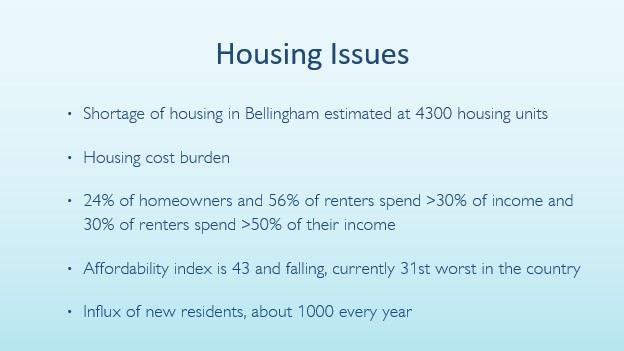
A 2023 estimate placed the number of new housing units Bellingham needs at 4,300. That is equivalent to 43 100-unit apartment buildings. 4,300 single houses would take up a whole lot more space. Where do we put this many people?
High costs are a big factor in the problem. John gave these statistics: 24% of homeowners spend more than 30% of their income on housing; 30% of renters spend more than 50% of their income on rent. How do they also pay for food, gas, insurance etc.?
John reiterated that one of the chief causes of homelessness is the lack of affordable housing in the city. When you pay upwards of 30% of your income to house your family, it takes only one or two setbacks to put you out on the street. Of course, other risk factors figure into this as well: bad childhood, alcohol or drug abuse, traumatic stress, etc.
Bellingham has an affordability index of 43. An index of 100 means that a family with a median income is able to purchase a median-priced home and spend no more than 30% of their income on housing. The higher the number, the more affordable housing is. It is no secret that Bellingham has expensive housing. We get more than 1,000 new residents a year, but there are not 1,000 new housing units available each year, so additional units for emigrees to live in are needed.
Factors like higher interest rates, shortage of skilled labor, supply costs, and infrastructure costs make new construction more expensive. Those costs are rolled into new housing costs. What can be done?
Relaxing zoning laws and land-use regulations (e.g., parking requirements) are two civic strategies, others include increasing housing density, expanding city limits, and streamlining the permitting processes. Income strategies include increasing wages for childcare workers, and offering subsidies for child care so parents can work.
John discussed some of the strides the city has been taking. The mayor is pressuring the Council to come up with solutions. Unoccupied buildings (the old public market) can be modified for habitation. Managed encampment areas might be considered.
We need to take care of the unhoused – they are residents of the city. Recent surveys have found less than 20% of the homeless have migrated from other locations in the nation. John raised many concerns and possible solutions and a good discussion ensued.
President Steve found his magic bell again and rang it with no noise to end the meeting.