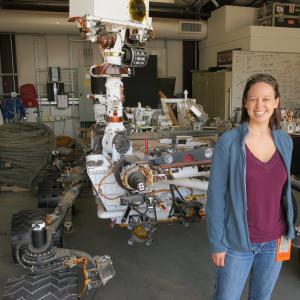
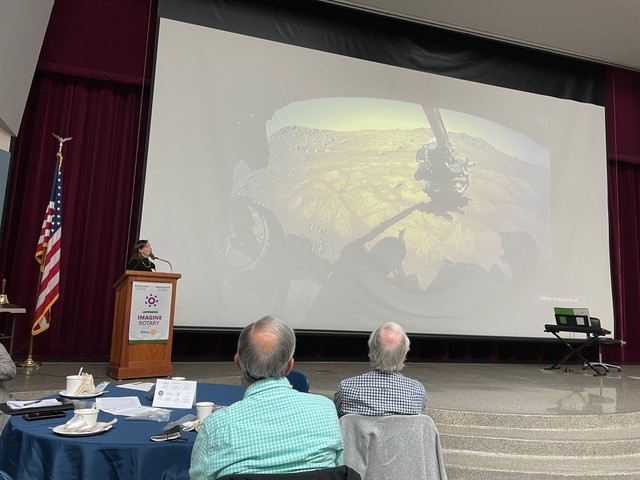
She began her talk by noting, that not more than about a hundred years ago, we knew almost nothing about Mars other than it looked like a red star in the sky. In time, we learned that it was a planet with a diverse surface with polar looking ice caps. While Mars is smaller than our earth it actually has as much land surface as our planet – as Mars does not have oceans. It has an atmosphere that is 100 times thinner than Earth
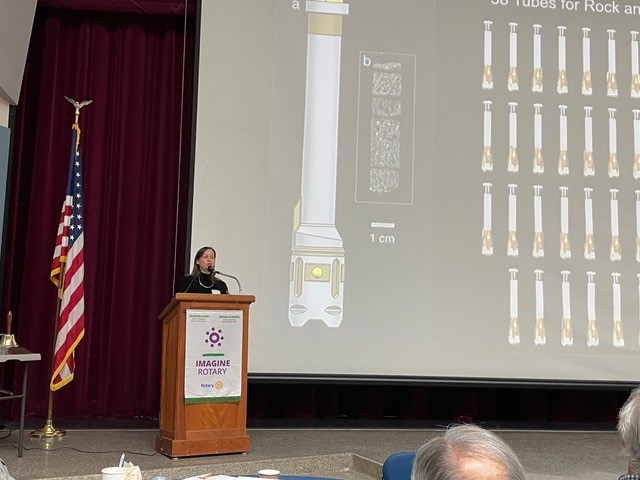
An important question, and mission of Perseverance, is the exploration of rocks on Mars to detect if water used to exist on Mars. The Mars arm will drill into the rocks. When the first drilling exercises were completed, they looked into the tubes, they were empty. The rocks they found, were much softer (“like butter”) than they looked and turned to dust when drilled. Drilling was then targeted toward harder looking rocks.
Dr. Rice noted that scientists believe that, about three and a half billion years ago, Mars not only had water but oceans. It may have looked like the Earth – with lots of water. Their mission is to see if there are water molecules in the rocks on Mars.
Perseverance landed near a crater they think once held water that spilled out into an adjoining delta – a sign of lots of water.
Perseverance is part of a three - part plan to bring rocks back to earth for testing.
Perseverance is the first stage. It has drilled for rocks and placed samples in most of its 38 tubes. 5 tubes are kept in reserve so, as she intimated with a smile, they would have the ability to store something they might find later – “like a dinosaur fossil”. Along with Perseverance is a small helicopter. (Imagine flying a drone from millions of miles away!) It’s been a big success to both demonstrate the technology but provide service to the mission. It scouts the way for the lander. In case Perseverance should fail, with all its valuable rock samples on board, the lander is dropping about half the rock tubes and leaving them on the Mars surface. The helicopter will be used to pick up and retrieve the samples to deliver to the vehicle they will land in the second stage.
The second stage of the plan is to land another vehicle on Mars that will collect the samples and blast off into orbit around Mars.
The third stage is a craft that will leave Earth, fly to Mars, retrieve the samples from the craft orbiting around Mars, and bring them back to Earth.
The time frame for the three-part plan is about ten years – hopefully completing it by 2029.
One of the questions the project hopes to answer is whether there was life on Mars. As Dr. Rice noted that if there was, there is a good bet the universe is “teeming with life”.
For those interested, you can get a daily update on the project by doing a search on Google of “Where is Perseverance Now”?
Closing:
After thanking those who helped to orchestrate the meeting President Paul adjourned the meeting.