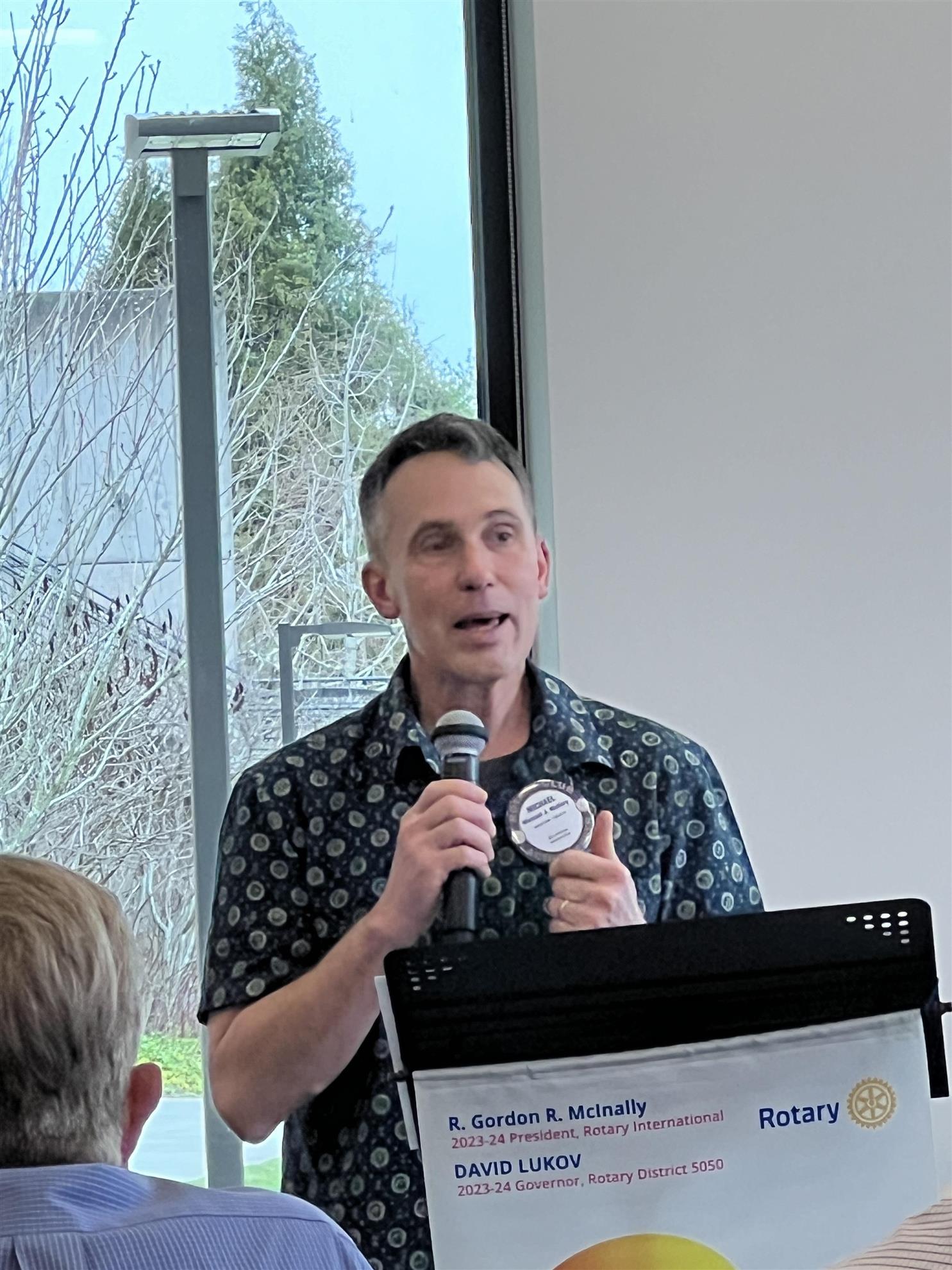
Our speaker was Ken Marzocco.
Ken graduated as a Mechanical Engineer and has spent the past 40 years working mainly in the engineering and construction of energy related projects. His experience includes leading more than 1000 people in the Americas from the North Slope of Alaska to Argentina. Most recently, he has been supporting “cleaner” gasoline and jet fuel projects which instead of crude oil, use feedstocks such as plastic waste, animal fats and natural gas.
Ken presented an overview of climate change from an engineer’s perspective. Filled with data and graphs, he outlined the challenges, misconceptions, and future strategy to address climate change.
He began with a graph showing the earth’s temperature and CO’2 data taken from ice sample over the past 400,000 years. Over this period, the earth has seen a sequence of rising temperatures followed by rising Co2. As temperatures rise, oceans can hold less CO2 – and a feedback loop is started.
He noted the impact of temperature changes. As temperatures decreased ~40F, the impact was devastating. Crops failed, livestock died, seal levels dropped, the Vikings abandoned Greenland and New York Harbor was frozen for five weeks. Tens of millions of people across Europe died. That was from just a 4-degree change. He asked us to imagine what happened some 43,000 years ago when the temperature change was 27 degrees.
He noted the history of California weather. People talk about the deluge that hit Californian last year (2023) but tend to overlook that in 1800’s California experienced a 20-year drought and in 1861 some ten feet of rain fell in a 43-day period. A lake formed that ran almost the length of California’s Central Valley.
Ken noted that scientists and politicians need to be realistic. Solar and wind now produce 3% of the world’s energy. The cost to date is $4 trillion. As such, he observed the goal of “net zero” is unrealistic.
He questioned some of the wisdom of our political “solutions.” For example, since the Keystone Pipeline was cancelled (that would have brought in oil from Alberta), the US has imported $150,000,000,000 worth of Russian oil and even more from Venezuela. He noted that several natural gas pipelines were rejected in the northeast. In turn, we purchased LNG at $11 (MMBtu) here natural gas would have $3. Meanwhile, 2.5 million homes in New England are heated with oil or coal.
Ken showed us a solar map of the United States. The state of Washington is the least efficient state to generate solar energy. Unsubsidized, a 5-kW residential solar system installation costs roughly $16,000 and only produces about $200 worth of unsubsidized wholesale electricity a year.
He noted the challenges of an energy grid that needs to be able to meet “peak demand” but often wind and solar are not available during these peak demand periods. For example, as the sun set, 13,000 MW of electricity from renewables disappears. As a result, we will continue to rely upon hydro, coal and natural gas.
Ken noted some of the successes. LED lightbulbs are 400% more efficient, aircraft engines have seen a 50% increase in fuel efficiency in 25 years, internal combustion cars are 40% more efficient in the last 25 years and LNG exports have reduced coal consumption.
He reminded us that we live on one planet, and we need one solution. Since 1990, the US population has grown 33% with no increase in CO2 emissions. Meanwhile, China and India have both increased their CO2 emissions five-fold during this period. While we seek to reduce coal burning, China is approving, as many as, two new coal fired plants per week and accounts for 68% of the total planned increase. India is second. With many nations in debt, we need to be practical about our investments that will yield true progress.
Finally, Ken suggested that emerging technologies may contribute to the solution including small nuclear plants, lithium recovery, geothermal (using fracking techniques), hydrogen and more.


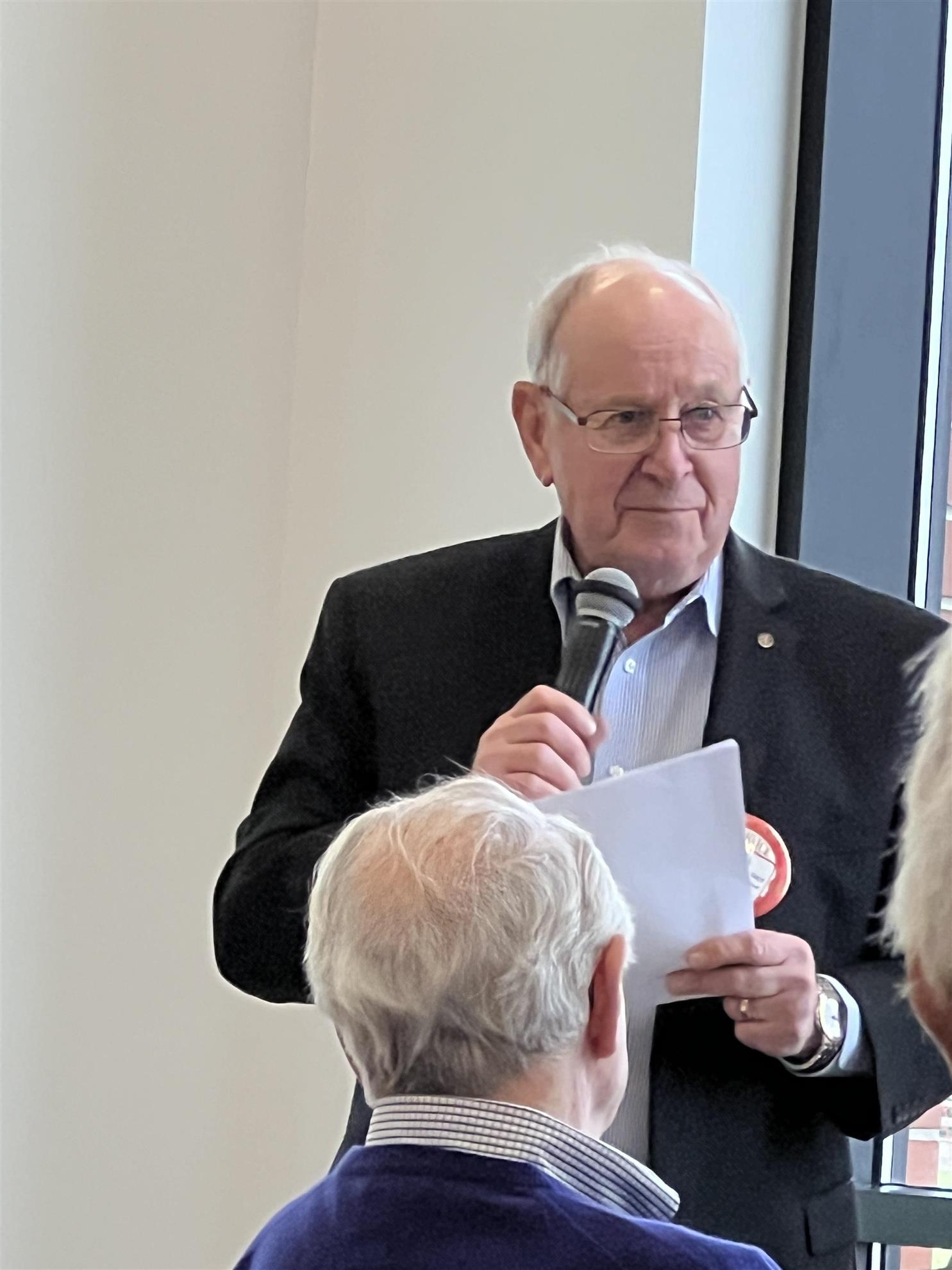
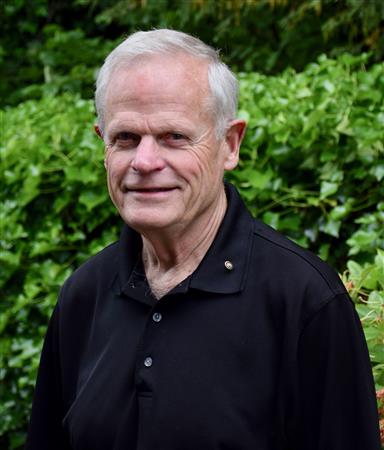 Honoring Bob Diehl