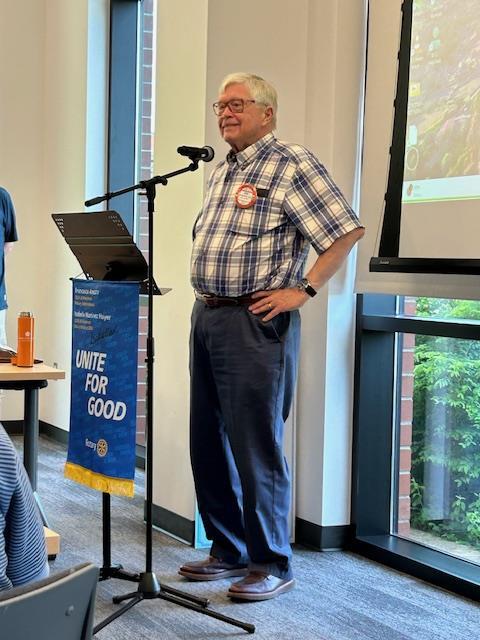
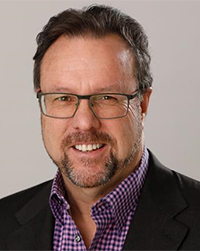
Nathan Twining introduced our own Dr. Roland Trenouth as speaker. Roland attended Columbia College and the University of Colorado for medical school. From 1973 to 1975, he received specialized training in cardiology, which he practiced in Bellingham until his retirement in 2007. Along the way, he led the Peace Health Emergency Room and the surgery center, and played a major role in bringing the cardiology specialty to Bellingham.
Roland’s topic was the state of health care in the United States today, titled, “Health Care Under Stress.”
Among the facts he presented were the size of the health care industry in the U.S. today, noting:
• Healthcare was 8.2 % of GDP in 1975
• Today it is the largest industry in the US - 18.4% of GDP
• It is expected that Healthcare (HC) will be 40% of GDP by 2050
• Americans spend more on healthcare than any other country -- almost twice as much as other developed nations
• Healthcare is the most common cause of bankruptcy in the US
• 50% of those declaring bankruptcy have insurance
• Americans spend many times as much money for out-of-pocket medical expenses as other countries
• We have more uninsured individuals than any other developed country
Roland reported that the cost of health care has risen 2000% since 1960- about four times faster than other items. Within health care, prescription drugs are up 69% since the year 2000. Hospital care is up 60%, and physicians’ services are up 23% in the same time period.
Roland discussed that there are four ways health care is funded around the world:
• Government HC (Socialized)–Military and VA
• Government Insurance-- Medicare and Medicaid
• Private insurance
• Out of Pocket
The US is the only country that uses all 4 methods, according to Roland. A large segment of the US population uses private insurance, and many people have no health care coverage at all. The U.S. is ranked 35th in the world in health care coverage.
Administrative costs are part of the problem.
• In 2020, the US spent $2,497 per capita for administrative costs on insurance, while Canada spent $551
• Private insurance companies’ administrative costs are about 18%
• Medicare administrative costs are only 2 to 4%
As to quality, as reflected in the associated population’s longevity, Roland reported that the US ranks in the bottom half or bottom third on most surveys and was ranked 63rd in 2024, with an average US life expectancy of 79.46 years; Monaco ranked 1st at 86.49 years.
Among the facts he shared:
• In 2023, the maternal mortality rate for women was 18.6 per 100,000 live births. For black women, the rate is 50.3, and a similar rate for native American women
• The rate in Canada is 7 and the rate in Scandinavia is 4 per 100,000 births
• Infant mortality rate in US was 5.6 per 1000 births in 2022 and among other countries is tied for 54th place with Qatar and Romania
Roland asked the question “Does healthcare insurance have any value?” And noted:
• We spend far more money on our healthcare system yet do not live as long and have high rates of mortality for certain conditions
• We have a significant portion of our population that does not have Health Care coverage: 25 million residents
• It is estimated that 44,000 to 82,000 people who are uninsured or underinsured will die in the US in 2026 because of a lack of insurance and healthcare
• He asked if the pending loss of subsidies for the ACA will cause that number to go up significantly
The increasing role of private equity (PE) in health care is another topic Roland covered
• In the last decade, PE entity ownership of hospitals/medical facilities has grown tremendously- from $41.5 billion in 2010 to $119.9 billion in 2019
• It increased even further to $200 billion in 2021
• PE is focused on short-term revenue generation
• Their purpose is to make money, not provide services
Along with that, he observed that for-profit (FP) nursing facilities had:
• Lower numbers of higher quality staffing
• Higher prevalence of pressure ulcers among patients
• Higher use of restraints
• Greater number of government-cited deficiencies
He also pointed out that 70% of dialysis centers are now privately owned and managed, and where patients have a 7 % greater odds of death – approximately 3,800 deaths a year.
As to the pharmaceutical industry, Roland reported that:
• It is currently a $1.6 trillion industry in the US
• Expected to be $3.22 trillion in 2033
• 41% of the industry’s profits come from the US
• The US is the only country that does not negotiate drug prices
Physicians, he said, are dissatisfied and there is a shortage of physicians coming:
• Dissatisfaction with their practices has led to increasing numbers leaving their practices or retiring early
• Physicians have the 2nd highest suicide rate of all professions
• Only 17% of today’s physicians are under 40
• By 2037 there is expected to be a shortage of 86,000 physicians
• There are similar shortages projected for nurses and other HC providers
Roland concluded his excellent and informative presentation by stating:
• Medicare will be broken by 2033
• Private insurance costs are escalating- will it be affordable in the future?
• If the ACA is not subsidized – how many people will be able to afford it?
• Medicaid - enrollment has been cut
• Uninsured - how many people will die due to a lack of HC insurance?
• Healthcare will be 40% of the GPD by 2050
• The COVID effect (Public Distrust of vaccinations and medical advice) is adversely affecting public health
• Quality and safety—Emphasis is on making money and not on quality, safety and preventive measures
• Providers- Will there be enough HC providers, and will AI fill the need?
President John grabbed the reins of a discussion that could of gone all afternoon to wrap up the meeting and thank all those who played a special role in making the meeting happen.